
Backpacking Georgetown, the capital of Guyana. This post details some of the things to see and do, plus some safety tips you need to be aware of.

I arrived in Georgetown exhausted from the gruelling 20-hour trip from Lethem.
Thank God that I was able to get a good night’s sleep at the Rima Guest House and recover quickly.

I was very hyped up about the possibility of visiting Kaieteur Falls.
I had been in contact with one tour operator back in March via email.
From Boa Vista, I wrote again to say that I was coming in a few days and then, to say, I am here in Georgetown. No reply.
I used a different channel for communication.
They replied that they had stopped doing the tours to the Kaieteur Falls because they were losing money as the flights needed to get there were forever being cancelled.
I messaged two other companies. It was a long weekend. No one answered.
Disappointed, I made plans to go to Suriname.
Then on the Monday, one tour operator replied to me that they didn’t have any availability until Wednesday, and they still needed more people before the trip would be confirmed.
It’s not exactly heaving with tourists here. I haven’t seen any backpackers since Manaus.
Plus it is still the rainy season. Though it hasn’t rained much in town, the Falls are a long way inland and in the highlands.
Also that the Kaieteur Falls ONLY trip is now a staggering 350 USD.
I couldn’t justify that. The same as when I was in Kenya or Tanzania. I never did a safari there (Zambia and Botswana were considerably cheaper).
And despite being a fairly successful blogger, I am not getting free accommodation (hotels never reply to me) or free tours. I used to get pissed off by this but I changed my attitude. If they don’t want the publicity or the promotion, then it’s their loss.
So I made do with backpacking the city.
Luckily there were some cool sights to see.
Georgetown has (or had) a bad reputation but I walked all over.
I was of course paying attention to my surroundings.
No walking with my phone in my hand. When I wanted to take a photo, I made sure I was away from passing traffic and that I couldn’t be a victim of a snatch and grab.
My backpack was clipped to the belt loop on my pants. Money for the day was in my zipped pocket. My passport locked in my bag in my room.
Paranoid? Undoubtedly so.
People are friendly enough. Even happy to pose for a photo:

I didn’t venture out at night. What for? To go to a bar? Or to fall in a drainage ditch full of agua negra?
I drank a couple (literally only a couple) of beers with my buddy Clay in Leticia and Manaus but since then, back to being teetotal even if I am sometimes gagging for a cold one. In 30 degrees C, feels like 34 with 80% humidity, one or even five would never be enough.
You might think that the Guyana National Museum would be included in the list of things to see and so in Georgetown.
But no. It could easily be renamed as The Stuffed Animal Museum. I’m not into that.
So here are my top 12 things to see and possibly do in Georgetown, Guyana.
1. Oasis Café
It’s hot and sweaty in Georgetown. The Oasis Café on Carmichael Street offers you an oasis of tranquility in this ever maddening world.
I went there for breakfast every day, having already toured the streets for an hour or so.
I had the Cheese Omelette, the Everything Omelette and the Bake and Saltfish, which is the classic Caribbean breakfast consisting of two fried dough balls called bakes, with sautéed, flaked salted cod.
It seems to be a hot local favourite but a bit too fishy for me.


They do a great coffee too.
Like everything here, it’s not cheap. But they accepted card payment.
There is AC, which is nice because my room back at Rima Guest House is fan only (I don’t actually use it to cool me down, the shower is perfect for that; but it speeds up the drying of my laundry).
The Wi-Fi works a treat. Guyana is massively underdeveloped but the Wi-Fi puts most of Europe to shame.
2. St. George’s Cathedral

I love the old wooden buildings in Georgetown. Some are in great shape. Some are falling down. But the St. George’s Cathedral is magnificent and dominates the central area of the city.
The cathedral as you see it today was designed by British architect, Sir Arthur Bloomfield. Work started on the cathedral in 1888, the foundation stone was laid in 1889.
In 1892, the church, though incomplete, was opened for worship and on November 8, 1894, the fourth version of St. George’s Cathedral was consecrated by Bishop William Proctor Swaby.
It also made a great landmark for getting my bearings as I was navigating the city without using my phone.
3. Stabroek Market

The Stabroek Market dates from 1881 and was partially built on land reclaimed from the Demerara River, yes Demerara Sugar comes from Guyana, which is why sometimes the market gets flooded and is not for the faint-hearted. There are some bad-ass smells in Georgetown.
The clock tower is particularly impressive, standing 18 metres tall.

It’s well worth a bit of exploration.
4. The Parliament of Guyana


Public Buildings, also known as the Parliament Building, was designed by architect Mr. Joseph Hadfield and built in Neoclassical Style in 1834.
It currently houses the seat of the National Assembly of the Government of Guyana.
5. Cathedral of the Immaculate Conception

The Cathedral of the Immaculate Conception, also known as the Brickdam Cathedral, is located on Brickdam Street.
The cathedral is one of the first Ferro-concrete structures to be built in the then British colony.
The church replaced St. Mary’s Cathedral which was destroyed by fire in 1913.
It was completed in 1927.
6. 1763 Monument

The 1763 Monument, commonly referred to as the Cuffy Monument, was unveiled in 1976 to commemorate the 1763 rebellion also known as the “Great Rebellion” that occurred on the Magdelenburg plantation in the Dutch West India Colony of Berbice, now Guyana.
The uprising which started on February 23, 1763, was considered the first organised attempt by slaves to fight for their freedom.
During the revolt, a slave named Cuffy from the Lilienburg plantation, quickly assumed a leading role in the rebellion and organized a number of riots against plantation owners.
The uprising lasted for more than a year.
It is located in the Square of the Revolution, across from the Independence Arch.
Be careful here. Not the most welcoming of places.
7. Independence Arch

This is a weird one. It’s at the eastern end of Brickdam Street by the Square of the Revolution.
The Independence Arch was unveiled on May 22, 1966, by Prime Minister of British Guiana, as it was known then, Mr. Linden Forbes Sampson Burnham, after they gained independence from the British.
It was designed by Canadian architect, Mr. Eric Flack and is constructed from aluminium. The three arches represent the three counties in Guyana and the six columns are for the six ethnic groups: Indian, African, Mixed, Indigenous, European and Chinese.
8. City Hall

The City Hall dates from 1889 and is one of the finest examples of Neo Gothic architecture in British Guiana.
It houses the offices of the Mayor of Georgetown and the City Council.
9. I Love Guyana Sign

I am still looking for the I Love Georgetown sign!!
10. The Seawall


This is an almost nice place to come in the late afternoon. The trash, to be honest, is depressing. Despite the bins provided, throwing it on the ground is so much easier.
The breeze is nice.
11. The Thousand Dollar Store

There are a few of these across town. They stock the normal dollar store knick-knacks and associated junk and many things are quite a bit more than a thousand dollars.
1000 G$ is actually 5 USD, so this goes to show how expensive it is here. I’d say double the costs if compared to Mexico City.
12. Buy Souvenirs
There are a few souvenir shops that have the usual stock of fridge magnets and badges and tourist tat.
I picked up a Guyanese flag patch.

Money also makes great souvenirs. They are in denominations of 20, 50, 100, 500, 1000, 2000 and 5000 Guyanese Dollars:


A word about the money. The local currency is Guyanese Dollars but US dollars are equally accepted at 1000 G$ = 5 USD.
I paid for my accommodation in USD, and at two restaurants. You get change in Guyanese Dollars. This is super convenient and saves going to the ATM and paying the ATM withdrawal fees.
I only used my card at the Oasis Café (no commission).

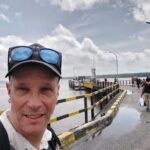
Cool looking place. I’d have skipped the waterfall too; a bit too expensive.
Good to see the rain let up for a bit. I love those dry days during the low season. A real treat.
I enjoyed seeing Georgetown and all the placesnin this trip but find them a bit boring after a few days. The heat and humidity is damn tough. I wear long pants and trekking shoes cos of the mosquitoes. Wet feet are my constant companion as the roads are often flooded. I fly today to Belem. Then Tuesday to Colombia where its only 18 degrees C. (32 feels like 38 here mostly).
Thanks as ever for re posting, re X- ing and comments
Always my pleasure. You are doing a smash-up job with creating content; especially in some uncomfortable conditions. Wet feet with wet roads, skeeters, long road trips, all that stuff can be tiring to deal with consistently. Well done.
Thanks Ryan. Toughing it out in Belem. The conditions here are extreme!! They have their own skid row here. Pretty ugly scene. And the feel like temperature is beyond hell. (Headed to Colombia for a 20 deg C drop im temperature.) Good to experience but. Not a place i wanna come back to.
You should also include the Botanical Gardens, which is a great birdwatching spot and there used to be at least 1 manatee in the garden’s canal that was regularly seen. There are Blue-and-Yellow Macaws, among other species of parrots, flying around in the mornings. Entrance was free in 2008. The national zoo is located adjacent to the gardens. Not too horrible and worth the small entrance fee.
Thanks for the additions. I dont like zoos. I know sometimes they are rescued or were orphans. But find them distressing.
Missed the botanical gardens though. Dang.
Want to know what the smells in the market were?!? Interesting fact about the sugar. Good read as always
Hi David it’s Agua Negra. The yuck smell you get in many developing countries is Agua Negra. Stagnant waste water mixed up with sewage.. bad drainage, broken pipes etc etc. And when it rains. Everything gets flooded.