The Churchill War Rooms, located beneath Whitehall in the centre of London. They served as the command centre from which Churchill directed the Second World War.
One of the Top Things To Do In London is to visit the Churchill War Rooms.
The Churchill War Rooms are situated beneath Whitehall. It was where Churchill and the British government led the war against Nazi Germany.
The Churchill War Rooms are one of five museums that are operated by Imperial War Museums (IWM) and house both the Cabinet War Rooms and the dedicated Churchill Museum.
Entrance to the Churchill War Rooms:
In 1938, with a war in Europe threatening, offices located beneath the Treasury building in the Whitehall area of Westminster became the temporary shelter for the British Government.
The War Rooms became operational just days before the Germans invaded Poland and Britain’s subsequent declaration of war on Germany.
On entering the museum, you’ll see an original German 250-kilogram bomb:
During the Blitz, bombs this size rained down on London.
Although No. 10 Downing Street was severely damaged, Whitehall and the Treasury never received a direct hit.
The basement offices were only 12 feet below the surface, so they installed a steel-reinforced concrete ceiling, known as “The Slab“, which afforded more protection.
Below the Cabinet Rooms is a sub-basement known as The Dock, where hundreds of servicemen and women lived throughout the war.
What to See Inside the Cabinet War Rooms:
Cabinet War Rooms:
This was the nerve centre of the Cabinet War Rooms in London. Churchill met with the members of the War Cabinet: Sir John Anderson, Clement Attlee, Lord Beaverbrook, Ernest Bevin, Arthur Greenwood, the Earl of Halifax and Sir Kingsley Wood.
On becoming Prime Minister in 1940, Winston Churchill visited the Cabinet Room and proclaimed: “This is the room from which I will direct the war.“
A total of 115 Cabinet meetings were held in the Cabinet War Rooms. The final meeting took place on March 28, 1945, coinciding with the cessation of the German V2 rocket attacks on London.
The room is arranged precisely as it was just before the 5 pm meeting on October 15, 1940.
Royal Marine Guards were positioned inside and outside the Rooms.
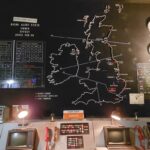
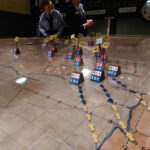
The Map Room:
This room was in constant use throughout the war and operated around the clock by Royal Navy, British Army and Royal Air Force officers, producing daily intelligence reports for Winston Churchill.
The Transatlantic Telephone Room:
Code-Scrambling, encrypted telephones enabled Churchill to speak directly with Roosevelt in Washington.
Churchill’s Office-Bedroom:
He reportedly slept at this location only three times during the war, preferring instead to stay at No. 10.
The PM’s Dining Room:
The Original No. 10 Downing Street Door:
This is the original oak door to No. 10 Downing Street, the home and office of every British Prime Minister from 1735 until 1991, when a blast-proof door replaced the original.
Margaret Thatcher opened the Churchill War Rooms in 1984.
Churchill Museum:
Learn about Churchill’s life in the Churchill Museum, from his early years to him become Prime Minister, leading the fight against Nazi Germany
Visiting the Churchill War Rooms: Location, Tube Stations & Opening Times
Location: The Churchill War Rooms are located in Central London, as shown on the map below:
Address: Clive Steps, King Charles Street, London, SW1A 2AQ
Nearest Underground stations: Westminster or St James’ Park, both of which are on the District and Circle lines, and less than 10 minutes away on foot.
Opening times: Monday to Sunday: 9.30 am to 6 pm, last entry at 5 pm.
Entry fees: For the latest ticket prices and opening times at the Churchill War Rooms, check the official Imperial War Museum website.





Seeing a semi-slim Churchill on that Life cover is interesting. I’m accustomed to seeing the heavier individual with a cane during his later days.
We were in this neighborhood a few times during a cardio sessions but never made it over. I dig the original oak door.