
Visiting the traditional houses ‘Hakka Tulou’ in Yongding, Fujian Province, China, over the New Year period, 2014/2015.
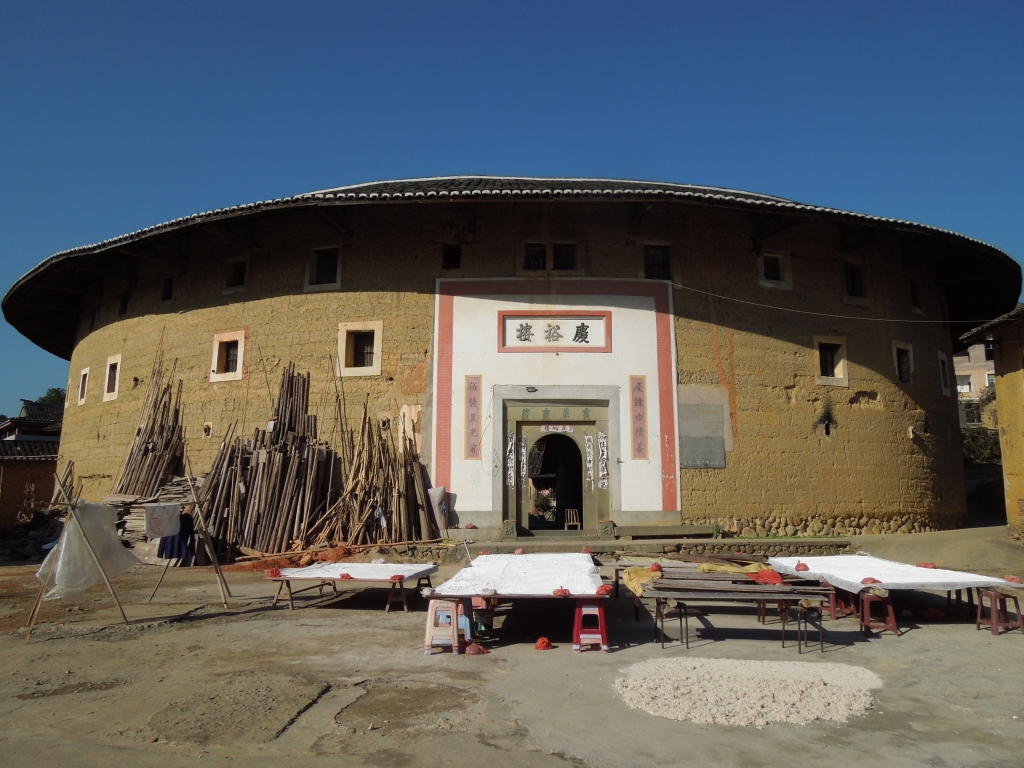
After my visit to the Longji Rice Terraces, I was in Guilin, Yangshou, Shenzhen and then Hong Kong, when I spent Christmas. Then I took a train from Guangzhou to visit Yongding and the Hakka Tulou.
The Hakka people are believed to be a subgroup of Han Chinese who originated in northern China and migrated south as early as the Qin Dynasty (221-206BC). They speak the Hakka language.
Tulou means Earth Dwelling. There are more than 20,000 Tulou scattered across Southeast China, mostly in Fujian Province (the one next to Taiwan).
It is said that they date back to the 11th century.
Back then, the natives were under constant attack not only by bandits but also by animals that, I guess, threatened their livestock, so they created these unique castles.
There were no windows on the first or second floors, and normally, there was only one gate allowing those who lived there to go out and in.
With at least one well inside and no blind spots, due to the mostly circular construction, the safety of the inhabitants could be ensured.
I chose the Yongding Tulou, but I could just as easily have visited the Nanjing Tulou.
I used the info that was available at that time. China Highlights had much more info when I went, especially regarding getting there and away, which was kind of essential in China, where Google Maps and all Google products don’t work.
4 Popular Hakka Tulou Areas in Yongding
Yongding Tulou refers to all the Hakka Tulou in Yongding District, Longyan City, Fujian, China. The best ones can be found in several specific areas known as clusters, including Hongkeng, Gaobei, Chuxi Tulou and Nanxi:
Hongkeng Tulou Cluster
The Hongkeng Tulou Cluster (洪坑土楼), also known as the China Hakka Tulou Folk Culture Village, is the main tourist area of Yongding Tulou.
The Zhencheng Lou, Fuyu, Kuiju and Wufeng Buildings and the circular Tulou in Yongding, the Rusheng Building, can all be found in Hongkeng.
Zhencheng Lou, known as the “Prince of Tulou,” is a magnificent double-ring Hakka Tulou and is one of the most famous Tulou in Fujian.
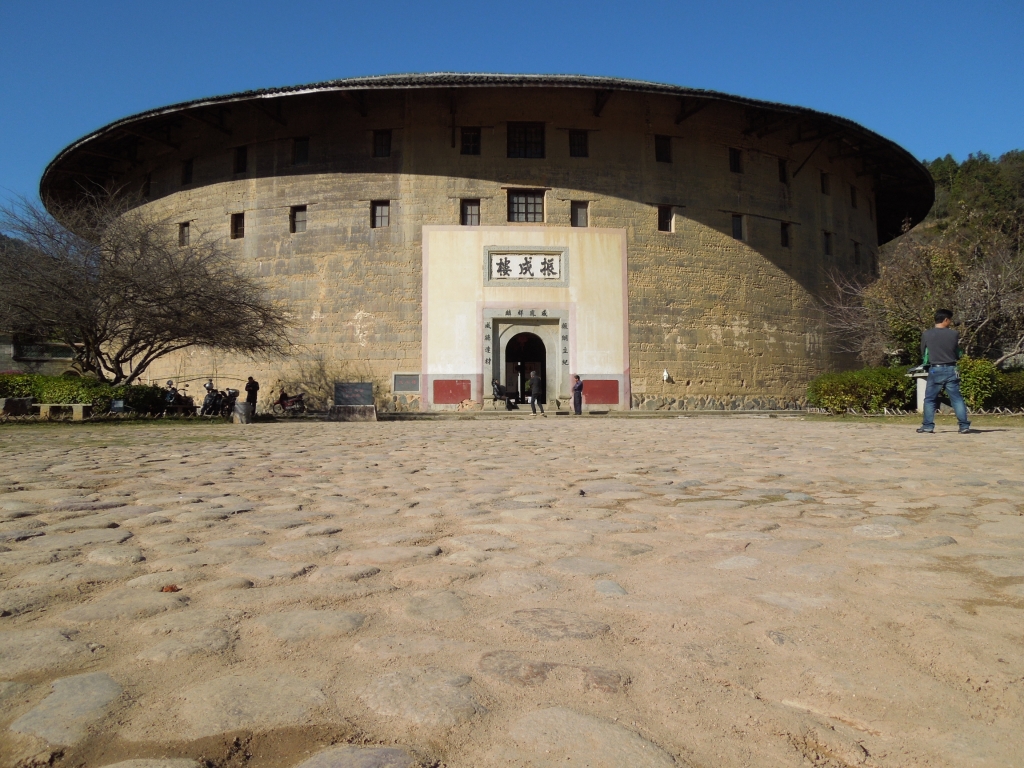
Built in 1912, the complex features two concentric rings of internal buildings, covering more than 5,000 m².
The outer circle, four stories high with two halls and 44 rooms on each floor, is made of rammed raw earth, divided into eight units partitioned by brick walls.


Each unit has its own stairway and yard below. There are 222 rooms in total.
Looking down at the courtyard of Zhencheng Lou:

The Tianhou Palace in Hongkeng is a traditional Mazu temple located right next to the iconic Zhencheng Lou Tulou:

(Guangyu Lou) is a notable square-shaped tulou located within the Hongkeng Tulou Cluster:

Unlike the Yuanlou roundhouses, Guangyulou is built in the traditional square design (fanglou). It is one of the older square structures in Yongding.
The Rusheng Building, the smallest tulou in Yongding:

Gaobei Tulou Cluster
The Chengqi Building (承启楼), in the Gaobei Tulou Cluster, is one of the most significant tulou of the 46 Fujian Tulou that have been listed as World Cultural Heritage Sites.
The massive round Tulou with four concentric rings surrounding an ancestral hall at the centre.
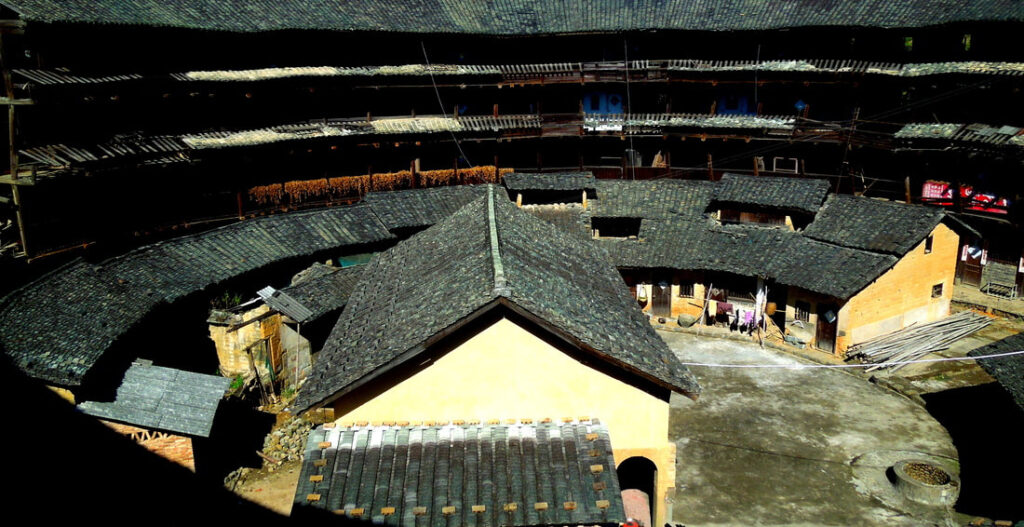
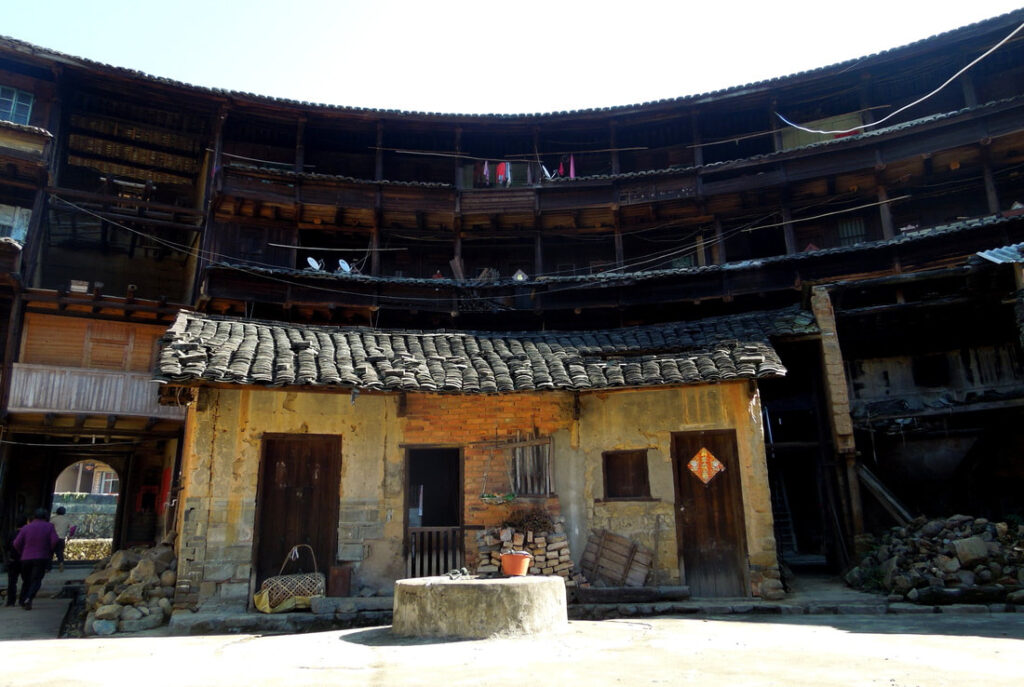
The exterior ring is the highest, while the inner ones get lower and lower as it gets close to the center. Such a unique structure makes Chengqi Building differ a lot from other Tulou of this region. The Chengqi Building is also the largest and also has the largest number of rooms (around 400.)

Qiaofu Building Gaobei Tulou in Yongding:

Other famous earthen buildings in this area include a three-ring Shenyuan Tulou.
The Shize Building (世泽楼) refers to the square Tulou on the east side of the Chengqi Building. It was built during the Qing Dynasty (1796~1820).
Shize Building is four storeys high. Each story has 38 rooms, and there are 152 rooms in total. All the rooms are made of wood and are built without the use of any nails, which is really incredible!

Chuxi Tulou Cluster
The Chuxi Tulou Cluster (初溪土楼) is composed of five round Tulou and dozens of square Tulou.
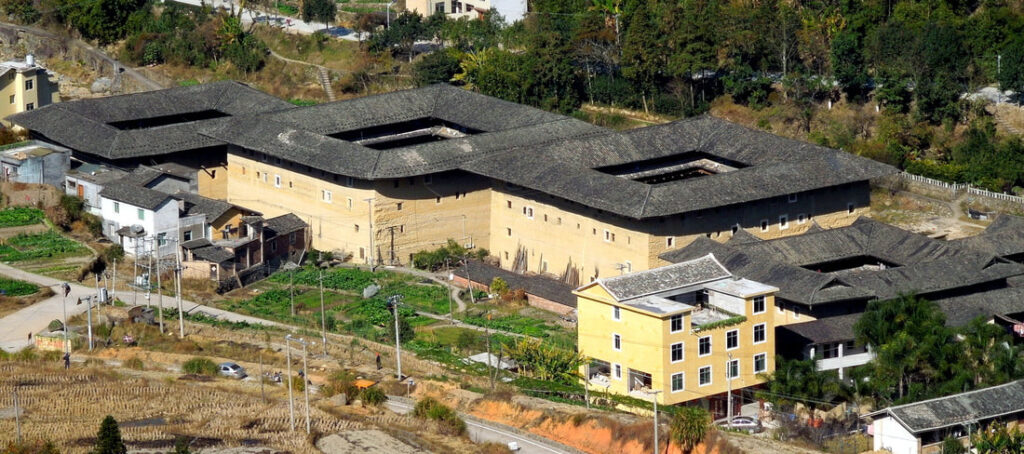
Qing Yu Lou Tulou at Chuxi Tulou Cluster:
Nanxi Tulou Cluster
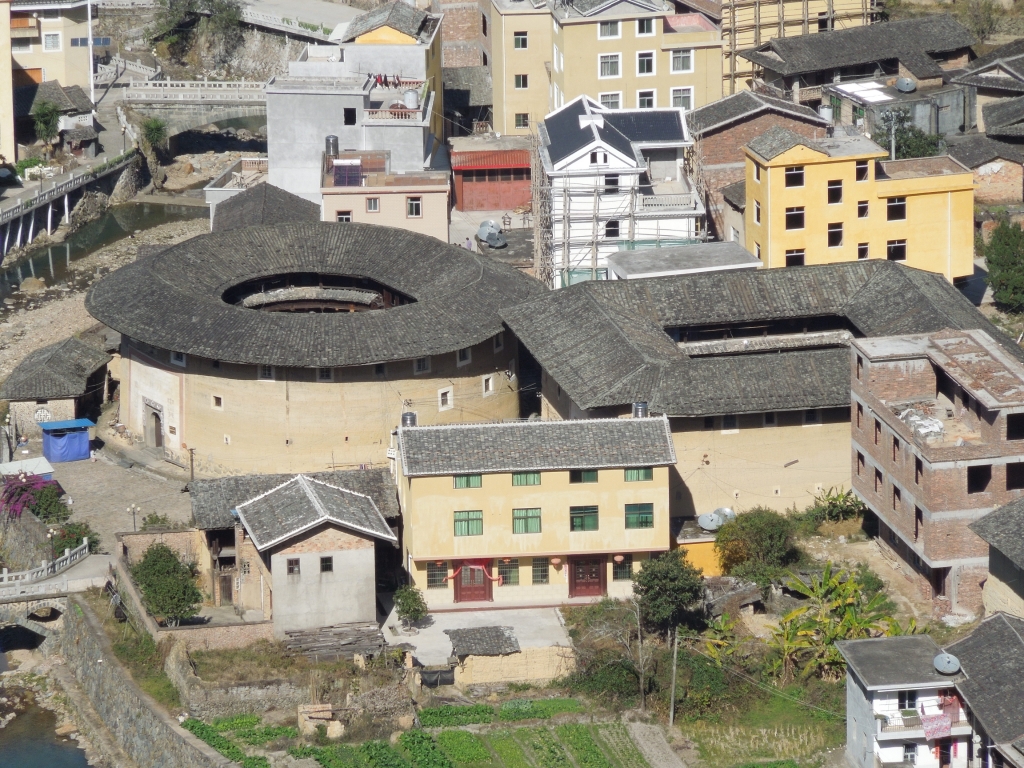
The Nanxi Tulou Cluster refers to the earthen buildings scattered in the terraced fields on the banks of Nanxi Stream in Yongding. This area has more than 100 Tulou.
Overlooking the Nanxi Tulou cluster, old and new:
I spent four or five very mellow and chilled-out days at the Fuyu Lou Changdi Inn. Western New Year’s Eve was celebrated a bit early at 7 pm with a few fireworks being set off.


With a small bottle of baijiu, I welcomed in 2015, alone under heated blankets.
Getting There and Away
As always, travelling in China tends to be a complete nightmare, but here’s how I did it back in 2014/2015. And I don’t speak Chinese. This was in the days before I had a smartphone.
I travelled by night train from Guangzhou to Yongding.
There is now a fast rail link from Xiamen to Longyan Railway Station, and from there, there are buses to the Yongding Scenic Area.
You can check trains and schedules on Travel China Guide.
For me, I arrived at Yongding at 4.40 am. I had planned to find a noodle shop and stay put until dawn, but a guy was waiting for the train (just as well, cos there was no noodle shop).
His family owned one of the few (at that time) guest houses in Liulian, the Fuyu Lou – Changdi Inn.
So I got a ride to the village, around an hour away, was shown their cheapest room, got in under the covers and went to sleep.
During my stay in Yongding, the village where I stayed is known as Liuliancun, and I walked everywhere.
When it came time to leave, I took a bus directly to Xiamen.


