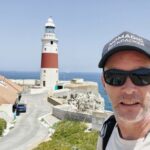
Here’s all you need to know about how to visit the Rock of Gibraltar.

I took a bus from Malaga to Línea de la Concepción, then crossed the runway to the British Overseas Territory of Gibraltar.

Can you walk up the Rock of Gibraltar for free?
No. It is no longer free to walk up the Rock of Gibraltar. It is part of the Gibraltar Nature Reserve, for which you must purchase a ticket, now priced at £30 for adults, £22 for kids (2026).
However, it includes entry to all the attractions and points of interest that you used to have to pay for separately.

You can purchase your ticket online at https://naturereserve.gi/.
I bought my ticket online and then had to validate my entry and get a special bracelet, which must be worn at all times.

Your ticket entitles you to access the Reserve and all attractions within it for one day.
The four official entry points are:
- Jews’ Gate
- Moorish Castle
- Devil’s Gap
- Cable Car Top Station
The three ways to access the Gibraltar Nature Reserve are:
- Walk
- Take a Rock Tour
- Take the Cable Car
Opening Hours: (May to October): 9.30 am to 7 pm / (November to April): 9 am – 6 pm
Closed on December 25 and January 1
Cable Car Tickets:
- One-way: £16.50 for adults, £9 for children
- Return: £19 for adults, £9 for children
Gibraltar Nature Reserve tickets:
- Adults: £30
- Children: £22
It is not a cheap day out by any means, but I saved myself some cash by walking up and down.
Here is a map of the Rock of Gibraltar, showing the points of entry and the attractions:

I walked up to the Moorish Castle and then followed the route in this order:
Moorish Castle, World War II Tunnels, City Under Siege Exhibition, Lime Kiln, Military Heritage Centre, Princess Anne’s Battery, Apes Den, Windsor Suspension Bridge, St Michael’s Cave, Sky Walk, Cable Car Top Station, O’Hara’s Battery.
I then descended the Mediterranean Steps to Jews’ Gate.
And from there, I walked back to town and the Emile Hostel.
Duration of my day: 9 hours.
My Top 10 Sights from The Rock of Gibraltar:
A few places didn’t make my ‘Top Sights List’, like the Lime Kiln or the City Under Siege Exhibition, though I did visit them.
Just to give you a brief background on the history of Gibraltar:
Gibraltar was founded in 1160, as a permanent watchtower by the Almohads, a North African Berber Muslim empire that controlled much of the Iberian Peninsula and North Africa during the 12th and 13th centuries. The Spanish occupied Gibraltar for 24 years in the early 14th century before being retaken by the Moors in 1333.
It was taken again by the Spanish and the Crown of Castile in 1462 and in 1704, it was captured by Anglo-Dutch forces during the Spanish War of Succession and was ceded to Great Britain under the Treaty of Utrecht on April 11, 1713.
Gibraltar became a British Crown Colony in 1830 and with the opening of the Suez Canal in 1869, the British needed to defend Gibraltar at all costs to control the Strait of Gibraltar.
1. Moorish Castle:
The Moorish Castle with its imposing Tower of Homage, is a medieval fortress built by the Moors (a term used by Europeans to describe the Muslim people of North Africa) during their occupation of the Iberian Peninsula during the 8th century.
When the Moors recaptured Gibraltar in 1333, they rebuilt The Tower of Homage, creating a tower within a tower.
It was later enlarged and reinforced by the Spanish during the 14th and 15th centuries and was used as a military barracks until the 20th century. Part of the Castle itself was used as the prison of Gibraltar until 2010.
You can climb up inside the tower for incredible views across the Bay of Gibraltar.


2. World War II Tunnels:
With Italy entering the war and the North African campaign, the need for storage space for food, ammunition, stores and men increased. Between 1940 and 1943, various regiments worked flat out, creating, by the end of the war, a 34-mile network of tunnels together with a hospital, a telephone exchange, a water distillation plant and a power plant. An underground city deep inside The Rock of Gibraltar.
Such was the strategic importance of Gibraltar for Allied Operations in the Mediterranean.
Two Royal Engineer Companies started the expansion of the tunnels that had already been dug over the last centuries in 1940, and were quickly joined by engineers from The Royal Canadian Engineers, who were more specialised in hard-rock mining.
Together, they built a fortress that could accommodate 16,000 men with enough supplies for up to 16 months if needed.


From Jock’s Balcony, you have a birds-eye view of the runway at Gibraltar airport:

They used names like, The Great North Road, after the A1 in England, or Clapham Junction, the busiest railway station:

3. Princess Caroline’s Battery:
The Princess Caroline’s Battery was built in 1732. Named after Princess Caroline, the daughter of King George II, the battery was updated in 1905, and a 6-inch Mark VII gun was mounted above the magazine. Later, the battery was decommissioned and the gun was removed. The underground magazine is now home to the Military Heritage Centre.
The battery saw action during the Great Siege of Gibraltar (an unsuccessful attempt by Spain and France to recapture Gibraltar from the British during the American Revolutionary War, June 24, 1779, to February 7, 1783.
Nearby is the Princess Anne’s Battery, often mistaken with the Princess Caroline’s Battery, which was inaccessible at the time.
The Military Heritage Centre is an underground museum dedicated to the military history of Gibraltar, from its earliest days as a British stronghold to its strategic importance in World War Two.


4. Windsor Suspension Bridge:
Hiking along the Royal Anglian Way, named after the Royal Anglian Regiment, you’ll come to the 71-metre Windsor Suspension Bridge. This is just a bit of tourist fun, as you can just as easily take the footpath.


5. St. Michael’s Cave:
St. Michael’s Cave is a network of limestone caves, 300 metres above sea level, on the Rock of Gibraltar.
There are many legends surrounding the cave. My favourite is that the caves were linked to a subterranean tunnel that passed under the Strait of Gibraltar, connecting Gibraltar to Africa, and this is how the Barbary Macaques or the Gibraltar Monkeys ended up here.
Another surrounds a Colonel Mitchell and his second officer who, in 1840, went into the cave on an exploring mission, and were never seen again.
100 years later, an expedition was launched to try to find out what happened to the two explorers. No secret passages, nor any remains, were ever found.


6. Sky Walk:

The Sky Walk is a glass-bottomed viewing platform opened to the public in 2018. Incredible views of the Mediterranean to the east. It is also a popular hangout for the Barbary Macaques.
7. Barbary Macaques:
Barbary Macaques or Macaca Sylvanus, are highly sociable tailless monkeys. Native to North Africa, it is believed that the Moors brought them here as pets or that they came through the tunnel under the Strait of Gibraltar.
They love to steal things: plastic water bottles, snacks. Anything that attracts their attention. They are said to be disease-free as they are monitored regularly. But I wasn’t about to play crash-test dummy.

8. Cable Car Top Station:
This is the cable car station, one of the four official entrance points for visiting The Rock of Gibraltar. There is an expensive restaurant and a souvenir shop.
Great views all round.


9. O’Hara’s Battery:
Located on the highest part of the rock at the southern end, the O’Hara’s Battery. It was constructed in 1890 and named after the then Governor of Gibraltar, Charles O’Hara.
It was last fired during exercises in 1976. The O’Hara’s Battery was opened to the public in 2010 and is one of only three surviving 9.2-inch gun emplacements at the upper ridge of the Rock.


10. Mediterranean Steps:
The Mediterranean Steps is the footpath which descends from O’Hara’s Battery down the Eastern side of the Rock to the Jews’ Gate.
There are warnings about not using the path if you suffer from vertigo, classifying it as difficult. This is just to stop those who turn up in flip-flops from attempting it. Yeah, it feels a little exposed at times but it’s just a series of steps, taking you down 241 metres.
Great views from the path:


The Rock of Gibraltar featured in the 007 James Bond film The Living Daylights, starring Timothy Dalton. He only featured in two Bond movies, the other being Licence to Kill; some scenes were filmed at the Centro Ceremonial Otomi just outside of Mexico City near Temoaya.
A successful day backpacking on the Rock of Gibraltar. Ending the suffering with a classic local beer: Bushy’s Gibraltar Barbary Beer: