
This is a backstory from 2018 when I backpacked Minsk using the 5-Day Visa-Free Program for Belarus, with visa details updated for 2026.

Five days gave me three complete days to explore. Not much, but it was what was available at that time. The regular 30-day visa was one of the most complicated and expensive visas to obtain.
Visiting Belarus in 2026:
Citizens of 38 European countries can enter Belarus visa-free through December 31, 2026, for stays of up to 30 days. This rule is valid at all international road, rail, and airport borders, with a maximum of 90 days in one calendar year.
Travellers from the USA need to apply for an e-Visa.
Is it safe to visit Belarus in 2026:
Looking at my Google Search Console results for Minsk and the most frequent search query is “Is Minsk safe?”
People are obsessed with this question.
Governments of the world are issuing warning notices about visiting Belarus.
The same Governments that never accept their own countries as being as dangerous as fuck.
I recall it was the same in 2018. In reality, Minsk was as safe as anywhere I have been, if not safer.
Just don’t get involved in any political shit. You are a tourist. Do touristy things.
Of course, the ongoing war between Russia and Ukraine might be something to take into account. But notice what I said. The war between Russia and Ukraine. Doesn’t mention Belarus, does it?
Belavia flight 852 from Gatwick to Minsk:

Boarding pass:


Belarus entry stamp:

These were the rules of the 5-Day Visa-Free Program:
- You had to fly in and out of Minsk International Airport
- You had to purchase the mandatory insurance upon arrival:

As of 2025, it is still required to have a certificate of health insurance to enter Belarus. You can buy online before you go.

On the ‘check-in’ floor, there were money changers. I cashed 5 Euros. Enough to get me downtown and some dinner. 5 euros got me 11 BYN. I used the ballpark figure of 2 BYN is 1 euro.
Buses from the airport to the city centre left from outside gate 5/6, ground floor arrival hall.
I opted for the 1400-TK, a 19-seat minivan, commonly referred to as a marshrutka.
I paid the driver directly. The fare was 4 BYN. It took about an hour.
I got off at the stop near the Victory Monument, from where it was a short walk to the Dreamy Castle Hostel. A bed in an 8-bed dorm room was just 8 USD per person per night (price is 2018). Lee Harvey Oswald is said to have lived at ul. Kamunistyčnaja 4 (Communist Street 4), the same block as the hostel. Sadly, it wasn’t, and still isn’t, possible to visit the apartment. It could have been a great museum.
Minsk – Capital of Belarus
Minsk is the capital and largest city of the Republic of Belarus, which gained independence from the Soviet Union in 1991.
Most of Minsk was destroyed during World War II.
Editing my original post, I see that, referring to Google Maps, I missed tons of things. Oh well.
The three full days that I had were nowhere near enough. In fact, I only had two full days as I made an excursion out of the city for a day. Two weeks would have been great. But alas.
Would love to return and explore Minsk and the rest of Belarus, now that I am a proper travel blogger.
Some of the Top Things to See and Do in Minsk Belarus
Drink a coffee at Stories
In 2018, Stories was the place to go for a coffee and a croissant (thanks to James of Nomadic Notes for the tip).

Ride the Metro
I generally walked everywhere within the city, but rode the metro for fun. The old Soviet metros are fantastic!
Now, the one-trip tokens called ‘jetons’ cost 0.90 BYN, or you can buy a multi-trip contactless smart card.
Plošča Lienina Metro Station:

With directions clearly stated using Roman characters too:

The Minsk Metro now has three lines with 36 stations, covering 44.89 kilometres.
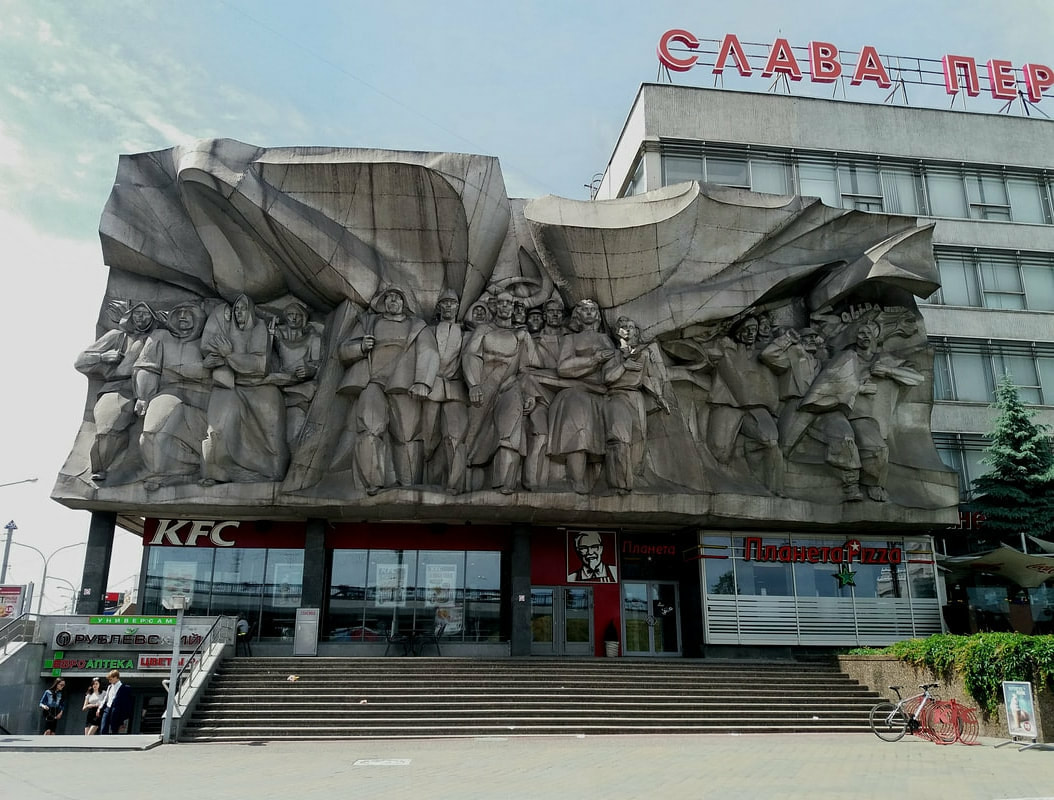
Solidarity Sculpture
The “Solidarity” sculpture which sits above the KFC, at the former House of Fashion, is a work which was inspired by “Vajacki marš” (“March of the Warriors”), the national anthem of the Belarusian People’s Republic that existed from 1918 to 1919.
The House of Fashion itself was built between 1962 and 1967 as part of the reconstruction of Minsk after World War Two. The sculpture was added in 1979.
Minsk Victory Square:
The iconic Minsk Victory Square is both a famous tourist attraction in Belarus and a place of pilgrimage for Belarusians remembering those who died in the Great Patriotic War (World War 2).
The square is dominated by the huge 40 m obelisk.
Previously known as The Circus, Victory Square was renamed and made into a memorial in 1954, when the obelisk was erected.
On July 3, 1961, an eternal flame was lit at the base of the obelisk.


Vorota Minska:
“Vorota Minska” translates to “Gates of Minsk” and refers to the two imposing, symmetrical Stalinist towers which flank Vulica Kirava, right across from the main train station.
They showcase classic Stalinist architecture, with grand facades, ornate details on a monumental scale.
They include the city’s largest clock with sculptures representing a worker, a collective farmer, an engineer, and a soldier – symbols of Soviet ideology and pride.
Built during the post-war Soviet era, they stand as traditional “guardians” of the city, greeting newcomers and symbolising the gateway to Minsk.


Lenin Monument:
The Lenin Monument is located on Independence Square (formerly Lenin Square), in front of the Government of the Republic of Belarus.
The monument was initially installed on November 7, 1933, to commemorate the anniversary of the October Revolution. However, during the Nazi occupation of Minsk in July 1941, the monument was destroyed, dismantled and sent to Germany for smelting.
Lenin was, if you didn’t know, a Russian revolutionary, politician and political theorist. He was the founder of the Russian Communist Party (Bolsheviks), inspirer and leader of the Bolshevik Revolution (1917) and the first head of government of Soviet Russia from 1917 until his death in 1924. He was also regarded as the greatest revolutionary thinker since Marx.

Patriotic War Memorial:
The Patriotic War Memorial in Minsk is officially the Belarusian State Museum of the History of the Great Patriotic War. It is the world’s first museum dedicated to the Second World War, opening in 1944.
Patriotic War is a term most commonly used in Russia. The term may refer to one of the following wars:
- French invasion of Russia, also known as the Patriotic War of 1812, Napoleon’s invasion of Russia
- Eastern Front (World War One), also known as the Second Patriotic War, was the war between the German Empire and its allies against Russia.
- Eastern Front (World War Two), also known as the Great Patriotic War in the Soviet Union, was the war between Nazi Germany and its allies against the Soviet Union.


Son of the Fatherland Monument:
The “Sons of the Fatherland” monument in Minsk, located on the Island of Tears, is a memorial dedicated to Soviet soldiers who died in the Soviet-Afghan War. It features statues of the women of Belarus mourning the loss of loved ones, the Mother of God and a weeping angel.

St Peter and St Paul Church:
The Cathedral of the Holy Apostles Peter and Paul is the oldest church in Minsk still in use. It was built between 1612 and 1630 together with a monastery of the same name. At the beginning of the 18th century, the monastery was almost destroyed during the Great Northern War.
The monastery church was renovated between 1793 and 1795, but the monastery was then dissolved.
In 1812, during the advance of Napoleon’s troops against Russia, it was destroyed by French soldiers and served as a field hospital for two months.
The church was renovated between 1870 and 1871 before being closed by the Bolsheviks in 1933 and reopened in 1991.

Cathedral of the Holy Spirit:
Holy Spirit Cathedral was built in the Baroque style between 1633 and 1642 as the main temple of the Catholic Bernardine convent. During the 1700s and 1800s, it was reconstructed to its present form. In 1852, the convent was closed, and its nuns were sent to Nesvizh town. In I860, the former monastic church was turned into an Orthodox church

National Opera and Ballet of Belarus:
The National Academic Grand Opera and Ballet Theatre of the Republic of Belarus: Bizet’s Carmen opened the theatre on 25 May 1933, though it was then at a different location. The building, as it is today, was opened in 1939 and was designed by the Belarusian architect Iosif Langbard. Swan Lake, performed by K. Muller, was the first show on the stage of the new theatre.

Drink a beer at the Happy Point Café
My favourite place to get a beer after a hard day backpacking was Happy Point Café, since closed, where 500ml draft beers were just 2.50 BYN:

I also made a day trip out of the city, visiting both Mir and Nesvizh on a single day using public transport, despite all reports available at that time, saying it wasn’t possible.
I don’t have enough photos to make the blog post complete, but here are two photos:

