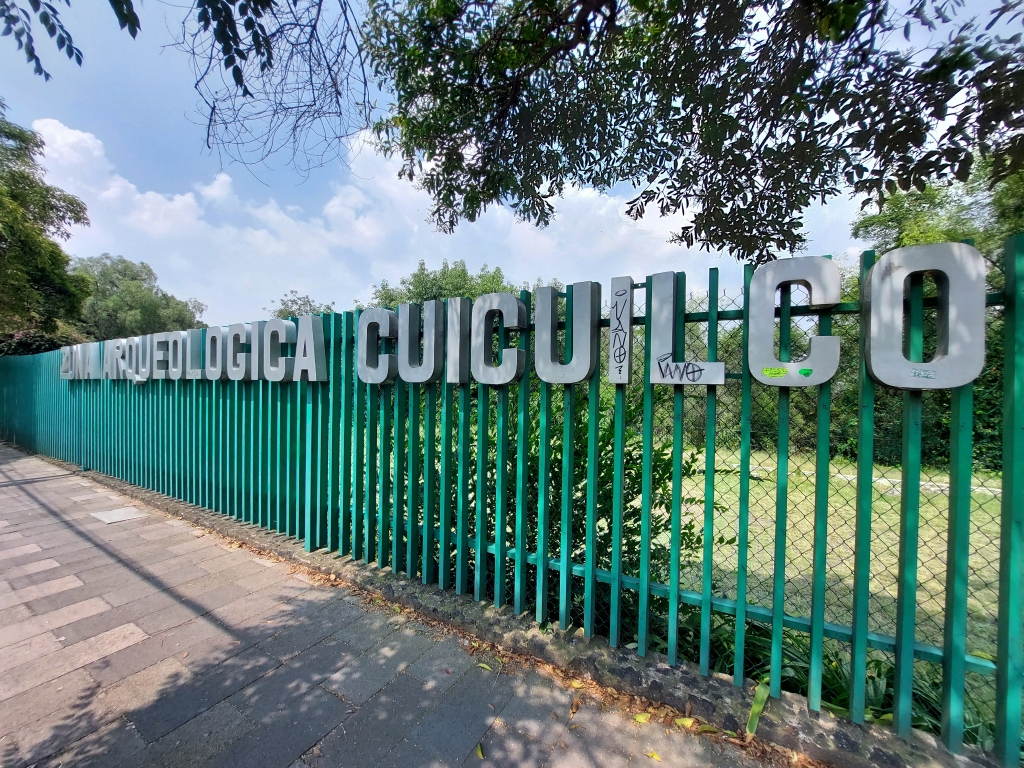
Despite being overshadowed by Teotihuacán, the Tula Archaeological Site is well worth the effort. Here is a raw, firsthand guide on how to get there from Mexico City. Updated August 2026.
We visited the Zona Arqueológica de Tula in January 2022 when the site had only just been reopened.
Tula was one of the most important cities of Ancient Mexico and reached its height as the capital of the Toltec Empire. It was inhabited for over 4 centuries. In the year 1000 A.D., it was a metropolis with tens of thousands of inhabitants, spread out over almost 16 km².
The large main plaza, with enormous platforms, stairways, altars, halls, palaces and ball courts, was located at the highest point of the city, thus dominating it. It was the city’s religious, political and administrative centre. The two massive pyramids, visible from almost anywhere in the city, were adorned with sculptures and countless polychrome bas-reliefs. Source: info plaque at the site
La Pirámide B:
This was one of the city’s most important sacred buildings, probably a royal sanctuary to which only the king and high priests were likely to have had access. The enormous columns in the form of human figures, known as ‘atlantes’, representing high-ranking Toltec Warriors, can be seen on the top of the pyramid. The giant stone sculptures held up the roof situated on top of the pyramid. Source: info plaque at the site
El Palacio Quemado:
This impressive architectural complex was made up of 3 grand halls with numerous columns and benches set into the walls. Ceremonies were probably held here in which the king and the ruling elite participated. Source: info plaque at the site
Juego de Pelota:
This is the smallest of the ball courts excavated at the Zona Arqueológica de Tula. A warrior found here was dressed in garments characteristic of the rain god Tlaloc.
Here Miss CDMX photobombs my pic, yet again:
Panorama from the main plaza:
From the site entrance to the archaeological site, you walk through some beautiful gardens with many cactus plants.
This is the Agave Azul, one of many they use to make Mezcal:
And the Maguey Pulquero used to make pulque:
And the Sábila used to make aloe vera:
After backpacking the archaeological site, we went and backpacked the small town of Tula. Not very inspiring actually, but you can go and look at the old railway station or the quite dull cathedral. Or pose in front of the Letras TULA:
How to get from Mexico City to Tula
Tula is just 90 km from Mexico City, so you can get there and back in one day.
We checked the schedule on ‘clickbus’ and just turned up at the bus station and bought the tickets, à la minute. Buses depart hourly or half-hourly, depending on the time of day.
We were thankful that, unlike all of our other day trips, we encountered no traffic problems. So we arrived on schedule at 10 am in Tula.
Information for Tula Archaeological Site: Location, Tickets and Opening Hours
You will arrive at the Central Bus Station in Tula, from where it’s a 2.5 km walk to the entrance of the Tula Archaeological Site as shown on the map below:
Tickets: (Updated for 2026 using the official INAH website for Tula):
General admission: 210 pesos.
Nationals and foreigners residing in Mexico: 105 pesos.