Discover the interesting, yet rarely visited port city of Limón on the Caribbean Coast, in Costa Rica.
I spent three nights, two days in Cahuita on the Caribbean Coast of Costa Rica. On my second day there, I backtracked the 43 km to the port and former railway town of Limón.
This post is from my travels in Costa Rica in 2022, but Limón hasn’t gone anywhere. There are no prices listed, so the content is essentially evergreen.
Limón, Costa Rica: Definitely not your typical backpacker destination. But lately, I am finding places with ‘nothing’ more interesting than the must-see places because there is always something to see (is this a sign that I have arrived at the end of the road?).
It might not be in the same league as the Arenal Volcano, Guanacaste or the La Fortuna Waterfall, but if you go someplace and just walk aimlessly, you always come across ‘something’.
So after a hearty Desayuno Completo (vegan) at Aroma Coffee Bar and Breakfast in Cahuita, Costa Rica:
I took the 9.50 am bus from Cahuita to Limón:
Limón is the first district and capital city of the canton of Limón, in the province of Limón, Costa Rica
The canton of Limón was inhabited by indigenous nations before the arrival of the Spanish. Christopher Columbus landed his ships on Quiribrí Island, now called La Uvita, which Columbus named La Huerta in September 1502.
Limón is a shipping port and cruise port, though the cargo terminal is out at Moín, 12 km away.
Limón was also the end of the line for the Costa Rican Railways, which ran from Puntarenas (a town I backpacked later in my journey) on the Pacific to San José and onto Limón on the Caribbean coast.
So, having arrived at the bus station, I followed the tracks through town to the old station.
Just a semi-derelict yard with some diesel shunters in various states of decay, but it is surprisingly in use. Wagons and carriages do get shunted around. The line did go all the way to Sixaola and into Panama. You can see the track on the bridge in old photos on Google Maps.
Amphitheatre of Limón:
Two blocks from the bus terminal is the rather odd-looking Catholic church:
Near the Vargas De Limón Park, you’ll find the Municipal Palace and the old Port Authority.
The Municipal Palace dates from 1942. The facade was designed by José Maria Barrantes Monge, one of the great architects in Costa Rica in the early 20th century.
Outside is a statue of indigenous hero Pablo Presbere.
Born in 1670, Presbere became the most feared warrior in Talamanca due to his bravery and valour in rebelling against the Spanish invaders in 1709.
The indigenous uprising stemmed from the injustices by the Spanish against the people in the Talamanca region.
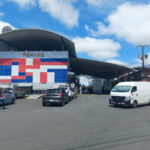
The Port Authority building dates from the 1930s and was used until 1986. The style is Afro-Caribbean.
There wasn’t too much to see but I am glad I visited:
2 thoughts on “Backpacking the Port City of Limón (Costa Rica)”
The Caribbean side is often overlooked. I’m glad you visited Cahuita and Limon.
We did a 6 week house sit DEEP in the jungle 3 miles outside of Bribri. No electricity. Outhouse. The real deal. It was an adventure for sure.
We headed into Puerto Viejo once weekly for provisions, a warm shower and real beds. We hopped over to Cahuita for a day too.
I heard that Limon was sketchy but it seemed OK based on your experience. I know the banditos used to hold up buses at times along the Caribbean side not too far from Limon. Things seem to be improving there.
The only places that felt, and actually were sketchy, were Pretoria, Pietermaritzburg and CapeTown… oh, and Tepito. I was in Tegucigalpa and San Pedro Sula… both have a very bad rep. but felt ok… of c at sun down, i was already back in my hotel







The Caribbean side is often overlooked. I’m glad you visited Cahuita and Limon.
We did a 6 week house sit DEEP in the jungle 3 miles outside of Bribri. No electricity. Outhouse. The real deal. It was an adventure for sure.
We headed into Puerto Viejo once weekly for provisions, a warm shower and real beds. We hopped over to Cahuita for a day too.
I heard that Limon was sketchy but it seemed OK based on your experience. I know the banditos used to hold up buses at times along the Caribbean side not too far from Limon. Things seem to be improving there.
The only places that felt, and actually were sketchy, were Pretoria, Pietermaritzburg and CapeTown… oh, and Tepito. I was in Tegucigalpa and San Pedro Sula… both have a very bad rep. but felt ok… of c at sun down, i was already back in my hotel