
Visiting Xalapa in the State of Veracruz, Mexico
I backpacked the city of Xalapa, the capital of the State of Veracruz, on a 3 day/2 night trip out of Mexico City.
The Teochichimecas, a nomadic and semi-nomadic indigenous group, established Xalapa as an important halfway point between the coast and the altiplano, Mexico’s high central plateau, in 1380.
The name Xalapa comes from the Nahuatl words xālli (“sand”) and āpan (“place of water”), which translates to “spring in the sand”.
Originally Xallapan, the Spanish changed it to Xalapa, with the alternative spelling Jalapa.
The pronunciation is Ha Lapa, just like in the name, the jalapeño pepper.
The city’s nickname, “City of Flowers”, was given by Alexander von Humboldt, after visiting the city on February 10, 1804.
It lies at 1414 m and is 300 km from Mexico City and 90 km from Veracruz.
I booked a room for two nights at Hotel Limon, on one of the booking sites, checked out the bus companies that operate on the Mexico City-Xalapa route on Rome2Rio, then booked directly on the ADO website.
I used ADO for the convenient departure and arrival points and the timing of the buses.
Here is my 8 am bus out of TAPO bus station in Mexico City:

Arrival in Xalapa, after 4 hours 20 on the bus from CDMX:

Two of the cheaper companies arrive a long way from the centre in Xalapa, but I got good deals nevertheless, by booking a few days in advance.
The night before, I used Google Maps to save a few top sights, cos my wife would be like, “You went to Xalapa and you didn’t see the XXX?” Yes, I sometimes miss things.
Things to see and do in Xalapa
Xalapa might be tiny compared to Mexico City, but there is still a lot to see.
Catedral Metropolitana de la Inmaculada Concepción
The Metropolitan Cathedral of the Immaculate Conception of Xalapa.
Originally built in 1641, the cathedral was reconstructed in the Baroque style in 1772. The bell tower remained unchanged. The clock was actually imported from England. In 1896, it underwent more modifications, and that is how it looks today:


Parque Juárez
The following are located in and around Parque Juárez:
- Monument to General Juan de la Luz Enríquez
- Quetzalcóatl monument
- “Pinacoteca Diego Rivera” art gallery
- Letras “XALAPA”
- Café Don Justo
The park is a nice place to come and sit and enjoy the shade. Xalapa can get pretty hot, and the streets are steep.

General Juan de la Luz Enríquez was born in Tlacotalpan on May 16, 1836. A Mexican military officer and politician, he served as governor of Veracruz from 1884 until his death in 1892.
He had a distinguished military career, reaching the rank of brigadier general. He participated in various conflicts, including the Reform War and the Battle of Puebla during the Second French Intervention in Mexico.
When he died, the city was renamed Xalapa-Enríquez in his honour:

Quetzalcóatl, the Feathered Serpent, is one of the most important gods of Mesoamerican culture:

Café Don Justo is a nice place to come for a coffee (they open early), breakfast, lunch or dinner. The terrace is the best place to enjoy the view of the mountains:

Pico de Orizaba (Citlaltépetl in Náhuatl), at 5,636 m, is the highest mountain in Mexico, the highest volcano in North America and the third highest mountain in North America after Denali (formerly Mount McKinley) and Mount Logan.
It is one of only three volcanoes in Mexico that still have glaciers and is home to Mexico’s largest glacier, the Gran Glaciar Norte.
And you can see it quite well from the Café Don Justo:

Barrio de Xallitic
The Totonac tribe settled in this place, which would later be called Xallitic. Its centre was the spring of crystal-clear water and the public washhouses, which have been symbols of the city of Xalapa since ancient times. The town’s temazcal baths were located in the ravine.
I was kinda disappointed by the much-raved-about Xallitic Barrio Magico. Nothing was happening there, and the old bathhouses are a place where all the homeless sleep.
- Puente de Xallitic
- Mural “El Paso de Cortés por Xalapa”


The Mural “El Paso de Cortés por Xalapa”, needs a touch-up:

Parque “Los Lagos del Dique”
The Parque Los Lagos del Dique is a nice place to come to enjoy some peace and get some exercise. It’s just a short downhill walk from the centre.
- X gigante
- El Águila de los Lagos
- Fuente Los Lagos
- Letras de Xalapa

X gigante:


El Águila de los Lagos (the Eagle of the Lakes), created by Guillermo Ramírez in 1926:


The sculpture inspired the Xalapa saying, “I won’t believe it until the eagle of the lakes flies.”
Letras de Xalapa:

Museo de Antropología de Xalapa
The Museo de Antropología is probably the highlight of any visit to Xalapa.

The MAX features 18 galleries, four courtyards, and six side rooms with more than 25,000 pieces belonging to the Olmec, Totonac, and Huastec cultures.
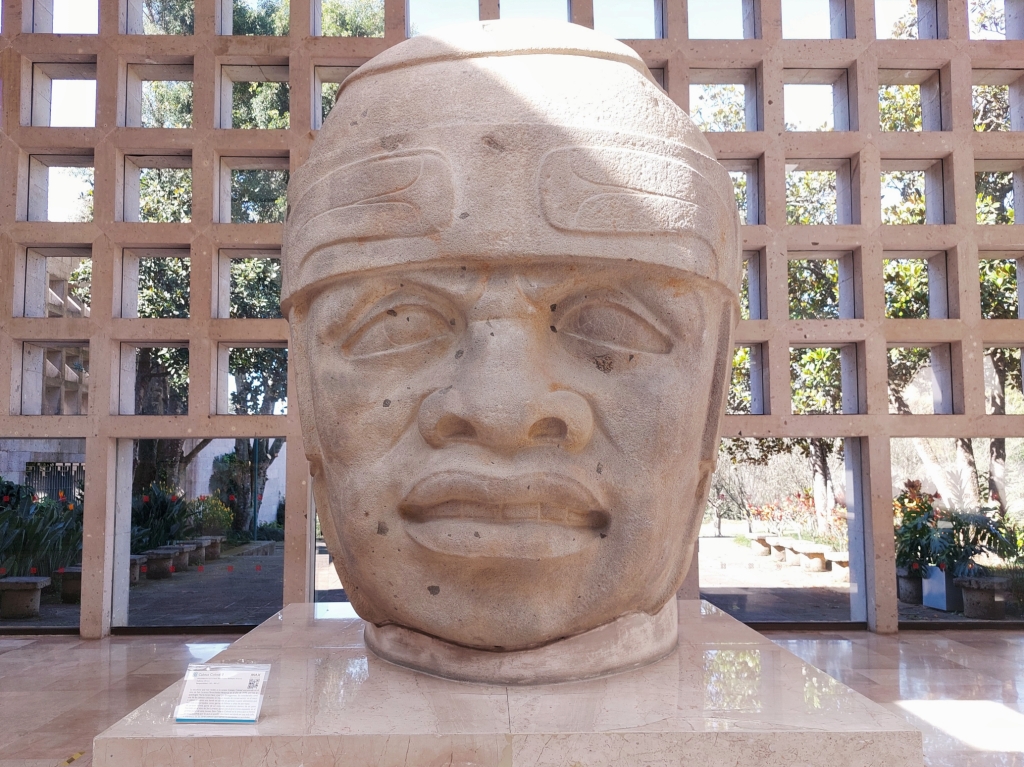
I was here primarily to see the Olmec colossal heads, and I wasn’t disappointed:

The cultural area of Mesoamerica comprises the southern half of Mexico, Guatemala, El Salvador, Belize, western Honduras and Nicaragua.
Within this region, there are five major cultural areas: the Central Highlands, Western Oaxaca, the Maya Lands, and the Gulf Coast of Mexico.
The Olmec culture was a civilisation founded and developed during the Preclassic period of Mesoamerica.
Although Olmec culture was spread throughout most of Mesoamerica, the clearest evidence has been found on Mexico’s Gulf Coast, the region which the Museum of Anthropology of Xalapa focuses on.
17 Olmec heads, which date from between 1200 and 900 BCE, have been discovered.
The Olmec Cabeza Colosal Número 1, was rediscovered (having been found at originally at Tres Zapotes in 1862 by José María Melgar y Serrano) at the archaeological site of San Lorenzo Tenochtitlán, in an expedition led by Matthew W Stirling in 1938.
Due to its size and artistic quality, it was called “The King.”
The Olmec Colossal Head, No.1:


Olmec Cabeza Colosal Número 8:
Cabeza Colosal Número 3:

Cabeza Colosal Número 9:

The Museo de Antropología de Xalapa is open Tuesday to Sunday, 9 am to 5 pm and costs (2026) 70 pesos, with free admission on Sunday.
Audio guides are available to rent in Spanish, French and English. Guided visits are also available on selected days. Check the website https://www.uv.mx/max/ for more details.
El Cerro de Macuiltépetl
Not too far from the MAX, is the Cerro de Macuiltépetl.
It is a small, monogenetic volcano with a conical shape and a steep slope (15 to 20 degrees). With origins that date back to the Late Pleistocene period (approx. 129,000 to 11,700 years ago).
It is now an ecological park where you can enjoy the flora and fauna: with 45 species of flowering shrubs, 15 species of butterflies, three species of amphibians, seven species of reptiles, and 182 species of birds.
It’s open from 7 am to 6 pm. It’s free to enter, and you must sign in and out.

The summit is at 1,700 m, a 100-metre hike from the entrance.
There is the Mausoleo de los Veracruzanos Ilustres:

Antigua Estación de Ferrocarril Xalapa
The railways are always an important part of a town’s history. You can see that Xalapa (Jalapa) was the end of the line on this old map of the railway network in Mexico (Wikipedia) from 1877:

Today, the line is used for freight, operated by Kansas City Southern de México.
An old Kansas City Southern locomotive, 4189 at Xalapa Station:


Kansas City Southern locomotive, 3003 at Xalapa Station


The station is not in use per se, though there is a maintenance crew and operations staff for the marshalling of freight:


The NdeM 281 loco, “El Trencito”, also known as El Piojito, can be found a bit to the west of the centre of town. A reminder of the city’s past:

The NdeM 28 2-8-0 Narrow Gauge Locomotive was built at the Baldwin Locomotive Works in Philadelphia, circa 1921.

Things to buy in Xalapa
Veracruz is Mexico’s second-largest coffee-producing state, known for high-altitude Arabica beans.
Coffee is grown in these three areas: Coatepec, Huatusco, and Cordoba
Coatepec is less than 20 km from Xalapa, a trip for another time, maybe. I bought 500 grams of coffee from the Mercado Jáuregui, though you could try this one on C. Primo Verdad in Xalapa:

The Bola de Ora is one of the cafe chains in Xalapa:


